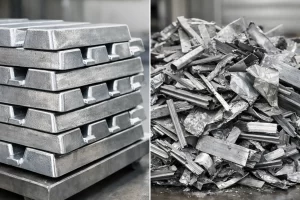

A delayed ingot shipment does more than slow purchasing. It can idle a casting line, disrupt cable production, force substitutions in fabrication, and push project costs higher than planned. That is why choosing bulk aluminium ingot suppliers is not just a pricing exercise. For industrial buyers, it is a decision about material consistency, grade suitability, logistics reliability, and long-term production stability.
Aluminium ingots sit at the start of too many downstream processes to treat supply casually. Whether the end use is construction profiles, electrical components, transport parts, packaging stock, or industrial manufacturing inputs, the supplier has to deliver more than volume. The right supplier delivers predictable chemistry, commercially useful lead times, and documentation that supports procurement, quality control, and production planning.
What industrial buyers should expect from bulk aluminium ingot suppliers
At a basic level, suppliers should offer clear grade segmentation, defined purity ranges, and realistic volume availability. That sounds obvious, but many sourcing problems begin with vague product descriptions and inconsistent communication around actual stock, production origin, or tolerance for quality variation.
A serious bulk supplier should be able to explain the difference between common ingot grades such as A7, A8, A9, and A6 and relate those grades to actual industrial use. Higher-purity material may support electrical and precision manufacturing requirements, while other grades may fit general casting or broader production applications where exact purity thresholds are less restrictive. Buyers should not have to guess whether a grade is suitable for conductivity, corrosion resistance, lightweight structural components, or secondary processing.
Volume capacity also matters, but capacity claims need context. A supplier may advertise bulk availability while operating through small, fragmented allocations. For a procurement manager, the real question is whether that supplier can support repeat orders at the same specification over time. One successful shipment is useful. A stable supply relationship is what protects production.
Grade, purity, and application fit
The best purchasing decisions start with the end use, not the catalog. Aluminium ingots may look standardized from a distance, yet application fit can vary significantly depending on purity, processing route, and the performance requirement of the finished product.
Why grade selection affects downstream cost
Buying a higher grade than necessary can raise raw material cost without improving the final product. Buying a lower grade than required can create a much more expensive problem – conductivity loss, poor finish quality, reduced corrosion resistance, or reject rates in manufacturing.
For example, ingots intended for electrical infrastructure usually demand close attention to purity and conductivity. Material going into construction products, transport components, or packaging may involve a different balance of strength, formability, and corrosion performance. Aerospace-adjacent applications or precision manufacturing typically allow less room for variation and more scrutiny around trace elements.
This is where supplier quality becomes visible. Good suppliers do not simply quote a price per ton. They help align ingot grade with processing requirements so that the buyer is not paying for unnecessary specification or inheriting avoidable production risk.
Ask for specification clarity, not just a grade label
A grade name alone is not enough. Buyers should request confirmation of purity, relevant chemical composition details, and product form consistency. If the supplier cannot provide straightforward technical information, that usually signals trouble later in the process.
Reliable supply partners understand that industrial customers need material data to support internal approval, plant acceptance, and customer-side compliance. The conversation should be technical and commercial at the same time.
Capacity is only useful when logistics are credible
A supplier can have strong material quality and still fail as a sourcing partner if shipping performance is weak. Bulk aluminium procurement depends on timing, load planning, and regional movement just as much as chemistry.
Industrial buyers should evaluate how the supplier handles packing, loading, shipment scheduling, export readiness, and order tracking. This matters even more when procurement spans multiple markets or when freight conditions shift quickly. A supplier serving trade routes connected to industrial hubs in China, Turkey, Vietnam, or Germany may bring useful experience in handling larger movements and more demanding delivery expectations, but the key question is still execution.
Late shipments can affect furnace scheduling, labor allocation, warehouse planning, and customer delivery commitments. That is why buyers should ask direct questions about lead times, minimum order quantities, replenishment frequency, and contingency planning. If the answers stay general, the risk remains high.
Price matters, but the cheapest ingot can become the most expensive
Industrial buyers are under pressure to control input cost. That pressure is real, especially in sectors where margins are tight and material spend is significant. Still, ingot sourcing should be judged on total commercial value, not invoice price alone.
A lower quote can lose its advantage quickly if the shipment arrives late, the grade is inconsistent, or the documentation is incomplete. Rejections, downtime, extra testing, emergency spot purchases, and customer delays can erase any apparent savings.
This is where experienced procurement teams look beyond the headline number. They compare quality consistency, order reliability, usable yield, and how often the supplier creates exceptions that internal teams must solve. The best suppliers reduce hidden cost. That is often more valuable than offering the lowest opening price.
What separates transactional sellers from dependable supply partners
Some suppliers are built to close orders. Others are built to support industrial operations. The difference becomes clear in how they communicate before and after the sale.
A dependable partner is responsive, precise, and comfortable with technical questions. They can discuss grade options, explain where a material fits best, and set realistic delivery expectations. They do not overpromise stock levels or use broad claims to move a purchase forward. When issues arise, they address them directly.
Transactional sellers tend to focus narrowly on tonnage and immediate pricing. That may work for one-off trades, but it is rarely enough for manufacturers and distributors with recurring demand. Buyers who need continuity should prioritize suppliers that understand forecasting, repeat ordering, and quality consistency across multiple purchase cycles.
For companies sourcing into manufacturing or project-based channels, supplier discipline matters as much as product quality. Stable communication reduces internal uncertainty. That has direct commercial value.
Why Cameroon-linked supply can matter to industrial buyers
For buyers evaluating origin and long-term resource relevance, Cameroon has practical significance in the aluminium value chain because of its bauxite base and its position within broader industrial supply discussions. That does not mean every buyer needs Cameroon-origin material for every order. It means buyers watching future supply options should pay attention to regions tied to aluminium raw material development and trade potential.
A supplier that understands both ingot grades and the upstream resource story can give procurement teams better context for long-range sourcing decisions. That is especially useful when businesses are balancing price pressure, diversification goals, and the need for reliable bulk availability.
At Aluminum Cm, the focus is on connecting industrial buyers with commercially relevant aluminium products while giving clear guidance on grade selection, use cases, and bulk order suitability.
Questions worth asking before placing a bulk order
The most useful supplier conversations are direct. Ask what grades are currently available in volume, what purity range is guaranteed, how repeat orders are managed, and what lead time can be supported without qualification. Ask how the ingots are packed, what documentation is included, and how the supplier handles a discrepancy claim.
It also helps to ask what industries the supplier already serves. A supplier experienced in construction and general manufacturing may not automatically be the best fit for electrical production or higher-spec industrial processing. Experience by application matters because it often reflects how well the supplier understands quality sensitivity.
If you are buying for a plant with strict process control, ask whether consistency from lot to lot is monitored closely. If your business depends on project delivery dates, ask how shipment reliability is measured. The right supplier will answer in practical terms rather than generic sales language.
The best supplier fit depends on your production reality
There is no universal best option among bulk aluminium ingot suppliers. The right choice depends on what your operation actually needs. A buyer supporting high-volume construction output may prioritize price stability and dependable replenishment. A manufacturer supplying electrical or precision applications may place higher value on purity control and tighter technical confidence. Export-oriented buyers may focus more heavily on shipping coordination and documentation discipline.
That is why supplier evaluation should stay grounded in your process, your tolerance for variation, and your delivery obligations. Bulk sourcing works best when commercial terms and material performance are aligned from the start.
The strongest buying decisions are usually the least dramatic. They come from suppliers who quote clearly, deliver consistently, and understand that every ingot order is tied to production, revenue, and reputation further down the line. Choose the supplier that makes your next order easier, not just cheaper.