A busbar that runs hot, corrodes early, or creates avoidable voltage loss usually traces back to one decision made long before installation – material selection. When buyers evaluate aluminium for busbar manufacturing, they are not choosing a generic metal input. They are choosing conductivity, forming behavior, weight, corrosion performance, and cost structure for the finished power distribution system.
For manufacturers, panel builders, switchgear producers, and infrastructure contractors, aluminum is often the practical answer when performance must be balanced against scale. Copper still has a strong position in many designs, but aluminum busbars remain highly relevant where lower weight, competitive pricing, and good electrical performance are priorities. The real question is not whether aluminum can work. The question is which alloy, temper, and production route will support the required duty cycle, joining method, and operating environment.
Why aluminium for busbar manufacturing stays in demand
The case for aluminum starts with economics, but it does not end there. Aluminum offers a favorable conductivity-to-weight ratio, which matters in large electrical assemblies, transport systems, renewable energy installations, and industrial distribution networks. A lighter busbar can simplify handling, reduce structural load, and improve manufacturing efficiency during cutting, punching, bending, and installation.
Corrosion resistance is another advantage, especially in applications exposed to moisture, industrial atmosphere, or outdoor conditions. Aluminum naturally forms an oxide layer that protects the surface. That does not remove the need for sound finishing and joint design, but it does support longer service life in many environments.
Cost also remains a major purchasing driver. For high-volume projects, the price difference between copper and aluminum can materially change total system cost. That is especially true when buyers are sourcing large tonnage for electrical infrastructure, fabricated conductor systems, or OEM production lines. In those cases, aluminum can improve project economics without forcing a major sacrifice in performance, provided the design is adjusted correctly.
What matters most in busbar material selection
Electrical conductivity is usually the first specification buyers look at, but it should not be the only one. Busbars also need adequate mechanical strength, dimensional stability, workability, and reliable joint performance. The best material for one project may be the wrong choice for another.
Pure or high-purity aluminum grades are often preferred when conductivity is the leading requirement. In general, the higher the purity, the better the electrical conductivity. That is why industrial buyers often look closely at feedstock quality and chemistry control when procuring aluminum for conductor applications.
At the same time, very high conductivity materials may offer lower mechanical strength than certain alloyed options. If the busbar will face vibration, repeated thermal cycling, heavy clamping forces, or complex forming operations, mechanical properties become more important. This is where trade-offs appear. Higher strength can support fabrication and service durability, but depending on alloy composition, it may slightly reduce conductivity.
Conductivity versus strength
This is the central balance in busbar design. A soft, highly conductive grade can perform well electrically, but if it deforms too easily during assembly or under load, the long-term result may be poor contact integrity. On the other hand, a stronger alloy may hold its shape better while carrying a small conductivity penalty.
There is no single right answer. Indoor switchboards, compact electrical cabinets, rail systems, substations, and solar collection systems can all place different demands on the busbar. Buyers should align the material grade with actual operating conditions rather than assuming the highest-purity option is always best.
Surface condition and joint reliability
Busbars succeed or fail at the connection points. Aluminum forms oxide rapidly, and that oxide layer is electrically resistive. This does not make aluminum unsuitable. It means contact surfaces, fastening pressure, coatings, and joining methods must be controlled carefully.
In many manufacturing settings, tin plating or other surface treatments are used to improve connection reliability and reduce contact resistance. The added processing cost may be justified where stable long-term electrical contact is critical. For some designs, bare aluminum is acceptable. For others, especially where dissimilar metals are involved, surface engineering is part of the specification, not an afterthought.
Which aluminum grades are used for busbars
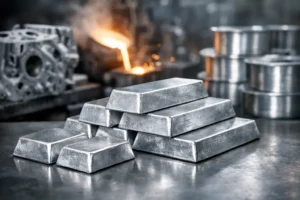
For busbar applications, commercially pure aluminum and electrical-grade aluminum are common choices because they combine high conductivity with good corrosion resistance and formability. Buyers sourcing raw material in ingot form should pay close attention to purity, trace elements, and consistency across batches, because downstream rolling or extrusion performance depends on chemistry control.
High-purity primary aluminum inputs can support busbar production where conductivity targets are strict. Grades positioned for electrical use are typically selected for predictable current-carrying performance and fabrication quality. If the production route involves extrusion, rolling, machining, and plating, uniformity in the base metal becomes even more important.
Some manufacturers also consider alloy series that improve strength or processability for specialized busbar profiles. That can make sense in structural-electrical components or systems with demanding installation constraints. Still, every step away from purer aluminum should be evaluated against the conductivity requirement. A cheaper or stronger alloy is not automatically the better commercial choice if it increases section size, heat generation, or energy loss.
Manufacturing considerations that affect performance
Even the right grade can underperform if the manufacturing process is inconsistent. Busbar quality depends on more than chemistry. It depends on how the material is cast, rolled, extruded, heat-treated, cut, and finished.
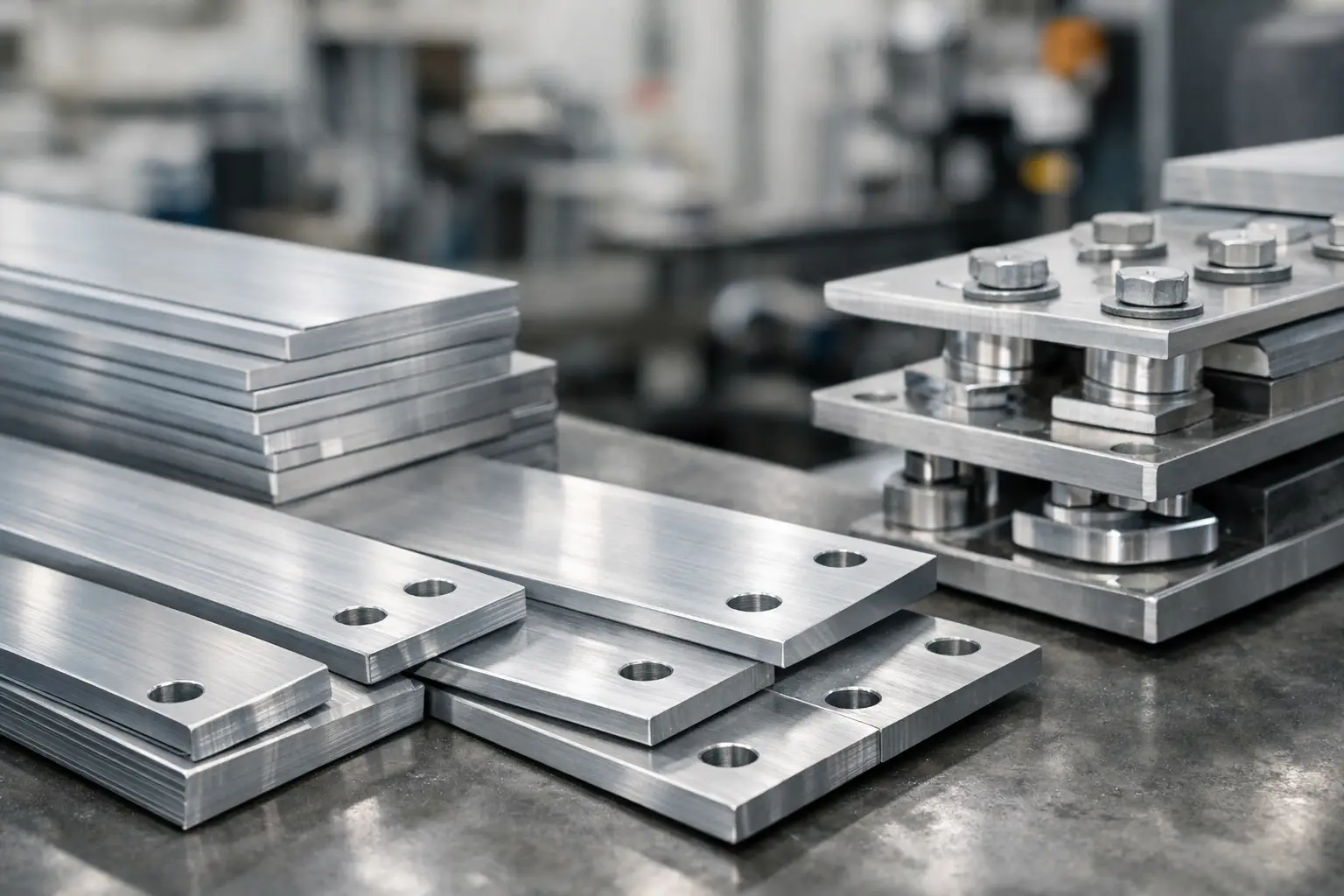
Flatness matters because uneven bars can create poor contact pressure across joints. Edge quality matters because burrs and defects can interfere with assembly and insulation systems. Dimensional tolerance matters because modern electrical equipment often uses compact layouts where busbar spacing, hole location, and bend radius must be exact.
Heat management is another practical concern. Aluminum busbars usually require larger cross-sections than copper to deliver comparable current capacity. That is not necessarily a disadvantage, but it changes enclosure design, support spacing, and thermal behavior. If a manufacturer switches from copper to aluminum without adjusting dimensions properly, overheating may follow. When the section is engineered correctly, aluminum performs reliably.
Extruded versus rolled busbars
Extruded busbars are often chosen for custom profiles, complex shapes, or integrated design features. Rolled flat bars are commonly used where simple geometry, consistent thickness, and efficient large-scale fabrication are the priority. The better route depends on the product design and production volume.
Extrusion offers flexibility, but rolled product can provide a cost and throughput advantage for standard rectangular busbars. Buyers should compare not only raw material price, but also downstream waste, machining time, and fabrication speed.
Sourcing aluminium for busbar manufacturing at industrial scale
Procurement teams should evaluate suppliers on more than headline purity. Batch consistency, documentation, production capacity, and application knowledge matter when busbar manufacturing is part of a larger commercial schedule. Delays caused by off-spec chemistry or inconsistent formability can affect fabrication output, delivery timelines, and final equipment quality.
For industrial buyers, this makes standardized ingot grades and dependable supply capability especially valuable. A supplier that can clearly position aluminum by purity range and intended use helps reduce qualification time. That matters for manufacturers producing switchgear, conductor systems, panel assemblies, or power distribution components in volume.
In cross-border supply chains, buyers also need to consider logistics reliability, packaging, and lead time visibility. This is particularly relevant for customers sourcing through industrial trade routes connected to China, Turkey, Vietnam, and Germany, where production planning often depends on steady bulk input flow. Material cost savings mean little if shipments arrive inconsistently or if quality varies between lots.
When aluminum is the better commercial choice
Aluminum is often the better choice when the project values lower material cost, reduced weight, corrosion resistance, and scalable volume procurement. It is especially attractive in large installations where total conductor mass affects transport, handling, and support structure design.
That said, some applications still favor copper. Very compact systems, high-vibration conditions, or designs with limited space for larger conductor sections may justify copper despite the higher cost. The smart buying decision is rarely about one metal being universally superior. It is about matching the material to the electrical load, mechanical demands, and project budget.
For many manufacturers, that balance points clearly to aluminum – especially when the raw material comes with reliable purity, predictable processing behavior, and sufficient volume for ongoing production. Suppliers such as Aluminum Cm serve this part of the market by focusing on commercially relevant aluminum grades, bulk availability, and practical application fit for industrial buyers.
A good busbar starts with realistic engineering and disciplined sourcing. If the material is selected with conductivity, strength, fabrication, and connection quality in mind, aluminum can deliver a durable and cost-effective result at scale.