
When a transmission project fails on material selection, the problem usually starts long before installation. It starts in specification – where conductivity, tensile strength, corrosion behavior, weight, and total line cost are treated as separate decisions instead of one engineering and procurement equation. This guide to aluminium for power transmission is built for buyers and project teams that need the material to perform in the field and make sense at scale.
Aluminium has become a standard material in overhead power transmission because it solves a difficult balance better than many alternatives. Utilities and manufacturers need a conductor material with strong electrical performance, manageable weight, good corrosion resistance, and commercially viable pricing across large volumes. Aluminium meets those requirements well, but the right choice depends on conductor design, environment, span length, and the mechanical demands of the line.
Why aluminium dominates overhead transmission
For overhead transmission, weight matters almost as much as conductivity. Copper offers higher conductivity by volume, but aluminium delivers a very favorable conductivity-to-weight ratio. That means more current-carrying capability per unit mass, which reduces structural load on towers and supports longer spans without the same penalty in dead weight.
That advantage changes the economics of a line. Lighter conductors can reduce demands on supporting infrastructure, transportation, and handling. In large grid projects, those savings are not minor. They influence tower design, installation methods, and long-term maintenance planning.
Corrosion resistance is another major factor. Aluminium naturally forms a protective oxide layer, which helps it perform in outdoor exposure. In many transmission environments, that behavior supports reliable service life, especially when material quality and conductor construction are properly controlled. It is not a claim that aluminium is ideal in every atmosphere. Coastal exposure, industrial pollution, and mixed-metal contact still require careful design decisions. But in broad utility use, aluminium remains one of the most practical conductor materials available.
Guide to aluminium for power transmission: what buyers should evaluate
A useful guide to aluminium for power transmission has to go beyond the generic statement that aluminium is lightweight and conductive. Industrial buyers need to know what affects real purchasing and real performance.
The first issue is conductivity. Pure aluminium has strong electrical conductivity, which is why high-purity grades are valued in electrical applications. However, power transmission is not only about conductivity on a datasheet. Mechanical performance matters because conductors operate under tension, weather loads, and thermal cycling. That is why many transmission products use engineered conductor designs rather than relying on one metal form alone.
The second issue is tensile strength. Pure aluminium is relatively soft compared with some alloyed or reinforced alternatives. In applications where long spans, wind loading, or high mechanical stress are expected, added strength becomes necessary. This is where conductor construction matters more than simple base-metal comparison.
The third issue is weight. Aluminium’s low density is one of its clearest commercial advantages. It allows more favorable strength-to-weight system design, particularly in overhead infrastructure where every kilogram affects support structures and installation cost.
The fourth issue is corrosion behavior. Aluminium performs well in many environments, but environmental conditions should still guide procurement. Humid regions, salt-laden air, and industrial atmospheres can affect conductor lifespan, fittings, and connection reliability. Material selection must consider the full system, not just the conductor core.
The final issue is supply consistency. For manufacturers and project buyers, material quality is not an abstract concern. Purity, dimensional consistency, and reliable volume availability directly affect downstream processing, conductor manufacturing, and contract delivery schedules.
Common aluminium conductor types
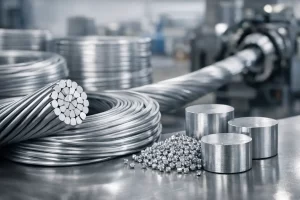
In power transmission, aluminium is often used in conductor systems designed to balance conductivity and strength. The most common example is AAC, or all aluminium conductor. AAC is used where high conductivity is needed and mechanical demands are relatively moderate. It is often suitable for shorter spans and urban or distribution environments where flexibility and corrosion resistance are valued.
AAAC, or all aluminium alloy conductor, uses aluminium alloy to improve strength while maintaining good corrosion resistance. This makes it useful where higher mechanical performance is needed without moving to a steel-reinforced design. In corrosive environments, AAAC can offer a practical advantage because it avoids the mixed-metal structure of some alternatives.
ACSR, or aluminium conductor steel reinforced, combines aluminium strands for conductivity with a steel core for strength. This is widely used in transmission systems where long spans and high tensile loads are expected. The trade-off is that while ACSR offers strong mechanical performance, it introduces a more complex corrosion and weight profile than all-aluminium options. In some environments, that trade-off is well worth it. In others, it may not be the best long-term choice.
These distinctions matter during procurement. A buyer sourcing aluminium for conductor manufacturing should be clear whether the priority is maximum conductivity, better corrosion behavior, higher tensile capacity, or a balanced outcome across all three.
Purity and grade considerations
For electrical applications, aluminium purity matters because conductivity is closely tied to chemical composition. Higher-purity aluminium generally supports better electrical performance, which is why standardized primary aluminium grades are relevant to manufacturers serving the power sector.
Grades such as A7, A8, A9, and A6 are often discussed in industrial supply because they indicate different purity levels and application fit. For transmission-related manufacturing, the required grade depends on whether the aluminium is being used in conductor production, electrical components, or other downstream applications tied to grid infrastructure. Higher purity can support conductivity targets, but the final material decision should also account for fabrication requirements and cost.
Procurement teams should avoid assuming that the highest purity grade is always the most efficient buying decision. If the application requires a balance of conductivity, processability, and price, the best commercial choice may differ from the highest available purity. The right supply partner should be able to match grade selection to end use, not simply quote tonnage.
Cost advantages and real trade-offs
Aluminium is often chosen because it helps control total project cost, but cost should be viewed properly. The material may offer lower installed system cost in overhead applications due to its light weight and wide availability. That can reduce structural demands and improve logistics in large-scale projects.
Still, lower density creates a design trade-off. To achieve equivalent electrical resistance performance, aluminium conductors generally need a larger cross-sectional area than copper. That is not necessarily a problem, and in many cases it is the better option. But it means conductor sizing, fittings, clearances, and line design must be evaluated as a system.
There is also a thermal trade-off. Operating temperature, sag behavior, and current load all affect line performance. If a project is expected to run under high thermal stress, conductor design and alloy selection deserve close review. Aluminium is an excellent transmission material, but it is not a one-size-fits-all answer.
Sourcing aluminium for transmission manufacturing
For industrial buyers, sourcing is about more than getting a competitive quote. The material has to arrive with consistent chemistry, reliable documentation, and the volume needed to support production schedules. In power transmission supply chains, interruptions are expensive. Delays affect manufacturing, project sequencing, and delivery commitments.
That is why bulk buyers typically focus on three issues: specification control, volume capacity, and application alignment. Specification control means the supplied aluminium matches agreed purity and form requirements. Volume capacity matters because transmission-related manufacturing can require substantial and recurring tonnage. Application alignment means the supplier understands whether the material is intended for conductor drawing, component fabrication, or another electrical end use.
For buyers serving export or regional infrastructure markets, this becomes even more important. Suppliers with experience supporting industrial demand across manufacturing centers such as China, Turkey, Vietnam, and Germany can add practical value when procurement involves larger production runs or internationally coordinated supply.
When aluminium is the right choice
Aluminium is usually the right choice for overhead power transmission when the project values a strong conductivity-to-weight ratio, corrosion resistance, scalable supply, and commercially efficient line design. It is especially effective where reducing structural load and controlling installed cost are priorities.
It may require closer evaluation when very high mechanical loads, unusual environmental exposure, or specialized conductor performance targets dominate the project. In those cases, the question is rarely whether to use aluminium at all. The question is which aluminium conductor design, alloy system, or reinforcement method best fits the operating conditions.
That is the practical value of a buyer-focused approach. Good transmission material decisions are not made by chasing one property in isolation. They are made by matching conductivity, strength, corrosion behavior, and supply reliability to the actual demands of the line.
If you are buying for conductor production or grid-related manufacturing, start with the operating conditions, then work backward to purity, form, and mechanical requirements. Aluminium performs best in power transmission when the specification is built around how the line will actually be used.