A profile that looks simple on paper can become expensive fast when the alloy is wrong. Cracking at the die, poor surface finish, weak corners, or extra machining after extrusion usually trace back to one decision made too early – material selection. That is why understanding how to select aluminium for extrusion matters before tooling is finalized and before volume orders are placed.
For industrial buyers, the right choice is rarely just about price per ton. It is about balancing extrudability, mechanical performance, corrosion resistance, finish quality, and downstream processing. If the extrusion will be used in construction, electrical systems, transport equipment, or general manufacturing, the alloy must fit the application and the production route.
How to select aluminium for extrusion by application
The cleanest starting point is the end use. Extrusion alloys are not selected in isolation. They are selected based on what the final part must do in service.
If the profile is for architectural framing, window systems, curtain walls, or general structural sections, buyers often prioritize corrosion resistance, appearance, and a stable extrusion process. In these cases, 6xxx series alloys are commonly preferred because they offer a practical mix of strength, formability, and surface quality.
If the part is for electrical busbars, conductor-related components, or heat transfer systems, conductivity may carry more weight than peak strength. If the profile will be machined heavily after extrusion, machinability becomes part of the selection logic. For transport and industrial assemblies, weight reduction and mechanical performance may justify tighter alloy specifications and stricter temper requirements.
This is where procurement teams can make a costly mistake. They ask for “aluminum extrusion material” as if it were one product. It is not. Alloy family, chemistry limits, and temper all affect performance and processing.
Start with the alloy family, not just the shape
Most commercial aluminum extrusions are produced from 6xxx series alloys, especially grades such as 6063, 6061, and 6005 or 6005A. They are widely used because they extrude efficiently and respond well to heat treatment.
6063 for appearance and standard architectural use
6063 is often the first choice when surface finish matters. It extrudes well, supports complex shapes, and typically produces a smoother appearance than higher-strength alternatives. That makes it common in visible architectural profiles, trim, frames, and light structural applications.
The trade-off is strength. 6063 is not weak, but it does not match the structural performance of 6061 in many conditions. If the application carries meaningful mechanical loads, the visual advantage of 6063 may not be enough.
6061 for higher strength and broader industrial use
6061 is one of the most recognized industrial aluminum alloys for good reason. It offers higher strength, good corrosion resistance, and strong versatility across structural and machined applications. It is often specified for transportation parts, machine components, support frames, and load-bearing sections.
The trade-off is extrudability. Compared with 6063, 6061 can be more demanding to extrude, especially in thinner or highly intricate shapes. Buyers should not assume that every cross-section is equally practical in 6061.
6005 and 6005A for structural extrusions
These alloys sit in a useful middle ground for many structural applications. They can deliver better strength than 6063 while still supporting efficient extrusion in many profiles. They are often considered for ladders, rail systems, transportation profiles, and engineered sections where strength-to-weight ratio matters.
Selection here depends on the exact profile geometry and required properties. In some cases, 6005A may give a better balance between manufacturability and final performance than 6061.
How to select aluminium for extrusion when geometry is complex
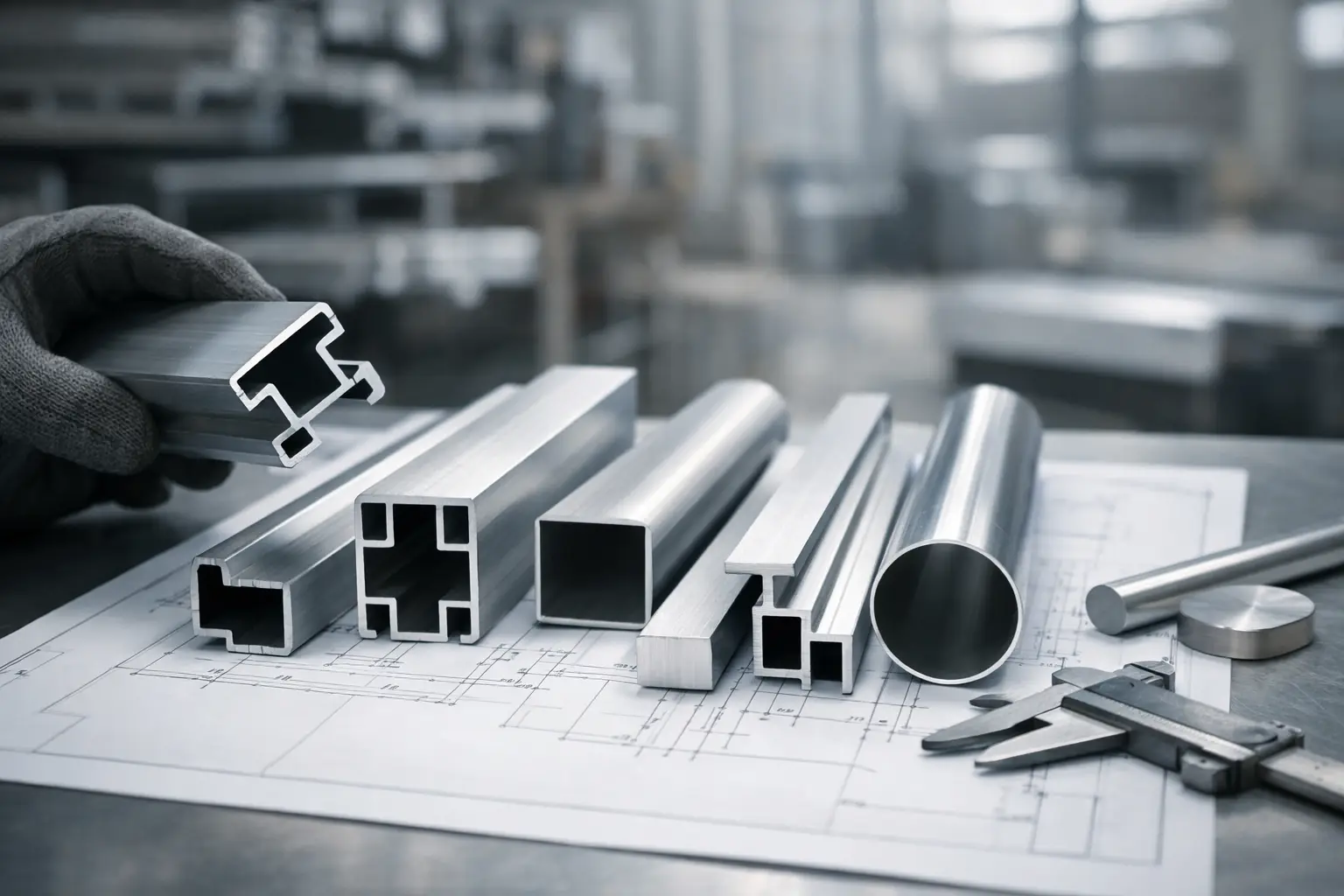
Not every alloy handles every profile equally well. Thin walls, deep hollows, sharp corners, asymmetrical sections, and tight tolerances all place more stress on the extrusion process.
A highly intricate design usually benefits from an alloy with better extrudability. That often points buyers toward 6063 or similar grades rather than a stronger but less forgiving option. If the profile is simple and thick-walled, the range of workable alloys expands.
This is where engineering and purchasing need to stay aligned. A stronger alloy can look better in a specification sheet but perform worse in production if the die design becomes difficult, scrap rates rise, or dimensional consistency suffers. Material cost is only one part of total cost. Yield, speed, die life, and reject rate matter just as much.
Match strength requirements to temper, not alloy alone
Buyers sometimes focus on alloy number and overlook temper. That creates gaps between expected and actual performance.
For extruded aluminum, tempers such as T5 and T6 are common. T5 means the profile was cooled from the shaping process and then artificially aged. T6 means it was solution heat-treated and artificially aged. In many 6xxx alloys, T6 delivers higher strength than T5, but processing route and cost can differ.
If the application includes static loads, impact exposure, fastening stress, or long spans, temper should be treated as a purchase-critical variable. A 6063-T6 profile and a 6063-T5 profile are not interchangeable in every design. The same applies to 6061 and other common extrusion alloys.
For procurement teams, the practical question is simple: what minimum mechanical properties are required in service, and what temper reliably delivers them?
Consider corrosion resistance and service environment
Aluminum is widely chosen because it is lightweight and corrosion-resistant, but service conditions still matter. Coastal exposure, humidity, industrial pollutants, alkaline contact, and mixed-metal assemblies can all affect long-term performance.
6xxx series alloys generally offer good corrosion resistance, which is one reason they are so widely used in building systems and infrastructure. Still, alloy selection should be reviewed alongside finishing plans. If the extrusion will be anodized, powder coated, or left mill finish, that decision can influence the most suitable alloy.
For visible products, the finish outcome can be as important as the base metal properties. Some alloys are more consistent for anodizing and decorative appearance, while others are chosen mainly for structural benefit.
Surface finish is a buying criterion, not a cosmetic afterthought
In many commercial projects, surface quality affects acceptance, rework, and brand perception. Curtain wall sections, consumer-facing trim, storefront framing, display systems, and finished industrial enclosures all require attention to appearance.
6063 is widely favored when a bright, clean surface is needed, especially for anodized products. If your extrusion is likely to be seen rather than hidden inside an assembly, this should be discussed before the alloy is approved.
A stronger grade may still be the right choice, but buyers should expect trade-offs. A profile optimized for load-bearing performance may require more realistic expectations around cosmetic finish, especially on complex shapes.
Think about downstream processing before you place the order
Extrusion is only one step. The material may later be cut, drilled, welded, bent, machined, coated, or assembled into larger systems. Those downstream steps should influence alloy selection from the start.
If welding is required, choose an alloy known to perform reliably in welded applications. If machining is extensive, consider how the alloy behaves under tool contact and whether the chosen temper supports dimensional stability. If bending or forming follows extrusion, the highest-strength temper may not be the best fit.
This is where commercially focused buyers gain an advantage by thinking beyond the mill. The best extrusion alloy is not always the one that performs best at the press. It is the one that supports the full production route at the lowest practical total cost.
Purity, feedstock quality, and supply consistency still matter
Even when the alloy designation is correct, feedstock quality affects results. Billet consistency, chemistry control, impurity levels, and process discipline all influence extrusion quality. Buyers sourcing large volumes should pay close attention to material certification and specification reliability.
For industrial projects, supply consistency matters as much as nominal grade. A dependable supplier should be able to define alloy chemistry clearly, support repeatability across batches, and align material supply with the production schedule. That is especially important for manufacturers serving construction, transportation, packaging, and electrical infrastructure where dimensional and performance variation can create downstream delays.
In bulk purchasing environments, buyers may already work with primary aluminum grades such as A7, A8, A9, or A6 for upstream manufacturing and remelt applications. Those grades are relevant to broader aluminum sourcing strategy, but extrusion alloy selection still needs to be tied to the final profile specification, not just base metal availability.
A practical way to make the final choice
If you need a reliable decision path, narrow the alloy by five factors: end use, profile complexity, required strength, finish expectations, and downstream processing. That framework usually eliminates poor-fit options quickly.
A decorative architectural section with thin walls and anodized finish often points toward 6063. A structural machine frame with higher loading may point toward 6061 or 6005A. A transport or infrastructure profile may require balancing strength with producibility, which is where supplier input becomes commercially valuable.
The strongest buying position comes from asking not just what alloy is available, but what alloy will run efficiently, meet the drawing, and perform in service without costly correction later.
Good extrusion programs are built before the first billet is heated. When material choice matches design, process, and end use, the result is not just a workable profile – it is a more predictable production line and a stronger purchasing decision.