Copper prices spike, grid projects stall, and cable manufacturers start recalculating fast. That is the commercial reality behind aluminium demand in electrical infrastructure. For utilities, EPC contractors, cable producers, and industrial buyers, aluminum is not simply a substitute metal. It is increasingly a planning decision tied to cost control, weight reduction, transmission efficiency, and long-term deployment at scale.
Electrical infrastructure now covers more ground than traditional transmission lines. It includes power distribution networks, substations, busbars, renewable energy interconnections, urban electrification, rail systems, industrial plants, and data-heavy facilities with rising power loads. As these systems expand, buyers are under pressure to secure conductive materials that balance performance with budget discipline. Aluminum fits that requirement in many applications, especially where lower weight and corrosion resistance create operational value.
Why aluminium demand in electrical infrastructure is rising
The biggest driver is volume. Grid expansion requires large quantities of conductive material, and aluminum offers a lower-cost path per installed length in many conductor applications. Its lower density means more conductor can be transported, handled, and installed with less structural burden than copper. In overhead transmission, that difference changes tower loading, installation methods, and project economics.
There is also a practical supply-side reason. Utilities and manufacturers do not buy metal in theory. They buy around lead times, price volatility, fabrication constraints, and specification risk. Aluminum has become more attractive because it allows designers to reach acceptable conductivity targets while controlling raw material spend across high-tonnage projects.
The renewable buildout matters as well. Solar farms, wind installations, and associated transmission upgrades require extensive cable, conductor, and connector systems. As electricity generation becomes more distributed, the amount of infrastructure needed between generation points and end users increases. That trend supports steady aluminium demand in electrical infrastructure, particularly in conductors and structural-electrical components where weight affects total system design.
Where aluminum is used across the electrical value chain
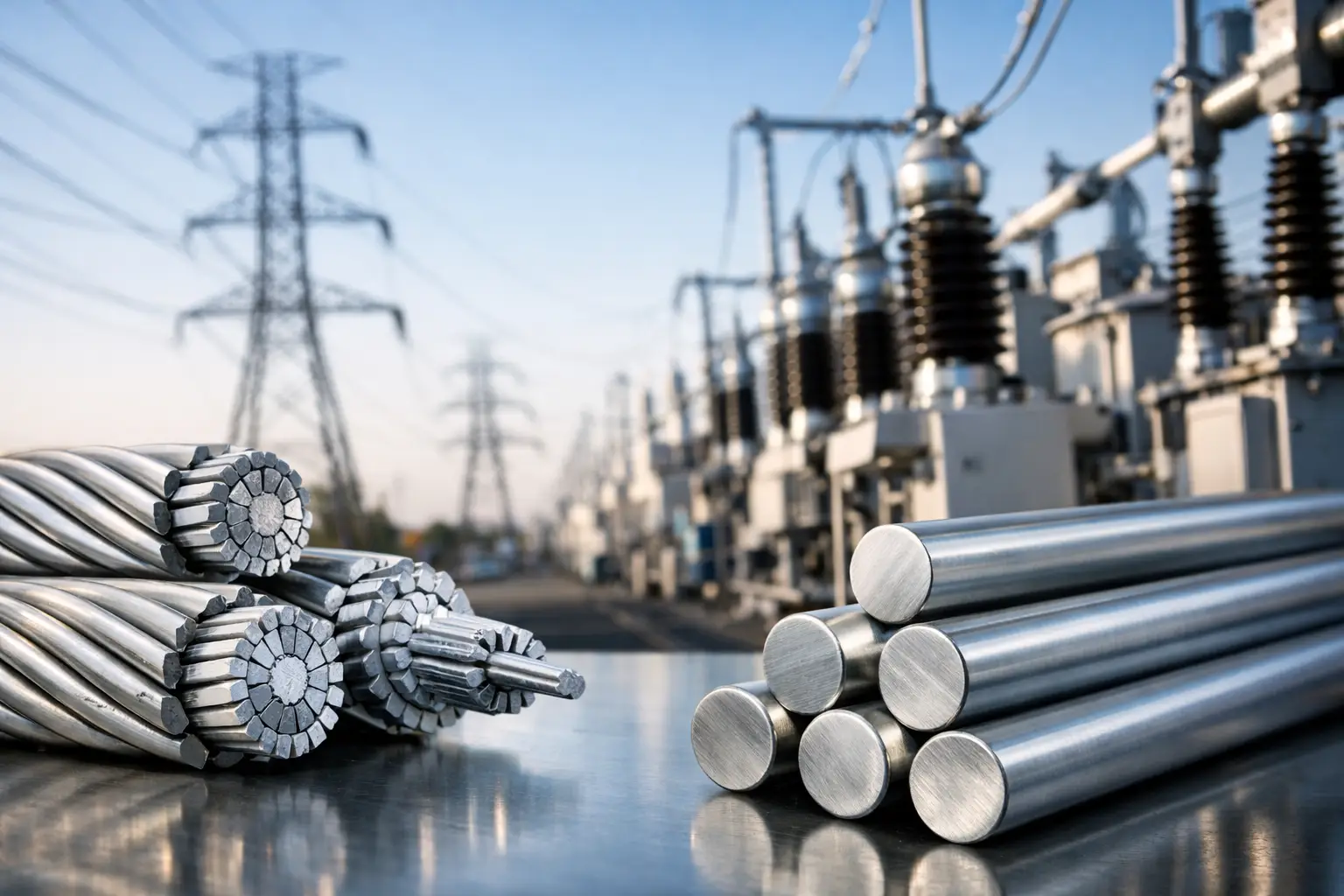
Overhead transmission remains the clearest example. Aluminum conductor steel reinforced products and related conductor types have long been used because they combine conductive performance with manageable weight. For long-distance lines, aluminum often provides a better commercial balance than copper, even if more cross-sectional area is needed to achieve similar conductivity.
Distribution networks also support demand. Medium-voltage and low-voltage applications increasingly use aluminum in cables, service lines, and feeder systems where installers and utilities are working to contain capital costs. In urban expansion and industrial park development, the economics become hard to ignore when cable runs multiply across large footprints.
Busbars are another area where the answer is more nuanced. Copper still holds a strong position in compact systems where maximum conductivity in limited space is critical. But aluminum busbars are widely used in switchgear, panel boards, substations, and industrial distribution equipment when design space allows for larger sections. The lower weight can improve handling, while the material cost advantage becomes meaningful in bulk procurement.
Transformers and substations add another layer. Aluminum is used in windings, connectors, and structural elements, depending on the equipment design and operating requirements. Not every transformer manufacturer favors the same material strategy, but aluminum remains established where cost efficiency and acceptable electrical performance align.
Conductivity matters, but so do total project economics
Procurement teams rarely make material decisions on conductivity alone. Pure aluminum has lower electrical conductivity than copper on a volume basis, so a larger conductor is usually required to carry the same current. That sounds like a disadvantage until the broader cost model is considered.
Because aluminum is much lighter, the installed system can become more economical even when more material volume is needed. Overhead lines may require less support strength per unit of conductive capacity. Transportation costs can improve. Site handling can become easier. For long-route infrastructure, those savings can outweigh the need for larger conductor dimensions.
This is where inexperienced buyers sometimes oversimplify the comparison. Aluminum is not the right answer for every electrical application. In tight enclosures, high-heat environments, or retrofit conditions with strict dimensional limits, copper may still be the better fit. But in many network-scale projects, aluminum performs well because the decision is based on the full installed cost, not only on conductivity tables.
What industrial buyers should evaluate before sourcing
The first issue is grade suitability. Electrical applications are sensitive to purity, conductivity, mechanical behavior, and fabrication performance. High-purity aluminum grades are often preferred where conductivity is central, but the exact choice depends on whether the material will be drawn into wire, rolled, cast, machined, or integrated into composite conductor systems.
The second issue is connection integrity. Aluminum forms an oxide layer quickly, which improves corrosion resistance but can complicate electrical joints if connection design is poor. Proper surface preparation, compatible connectors, and correct installation practices are essential. In other words, the material does its job when the joint design does its job.
Thermal expansion should also be reviewed. Aluminum expands more than copper, which affects terminations and long-run installations. This does not make aluminum unsuitable. It means engineering tolerances, fastening systems, and maintenance procedures must reflect the operating conditions.
Buyers should also ask whether the application is indoor, outdoor, coastal, or industrially corrosive. Aluminum performs well in many outdoor environments because of its natural corrosion resistance, but local conditions still influence alloy choice, finishing requirements, and expected service life.
Aluminium demand in electrical infrastructure and supply planning
Demand growth is only useful if supply is dependable. Electrical infrastructure projects consume large tonnage, and schedule delays quickly become expensive. That is why serious buyers focus on more than price per metric ton. They need confidence in grade consistency, documentation, purity, and repeat-volume availability.
For cable makers and component manufacturers, inconsistent feedstock can disrupt drawing, extrusion, and finishing performance. For project buyers, variable specifications create risk at the approval stage and during installation. Reliable aluminum supply must support both metallurgy and procurement planning.
This is especially relevant in markets serving regional manufacturing and export-oriented industrial production. Buyers sourcing across China, Turkey, Vietnam, and Germany often compare not only spot pricing but also logistics reliability, specification discipline, and the supplier’s ability to support ongoing production demand. In that environment, standardized ingot grades and clear application guidance help reduce sourcing friction.
A supplier that understands the electrical segment should be able to discuss more than purity percentages. They should be able to speak clearly about application fit, conductivity priorities, fabrication pathways, and volume readiness. That is where product knowledge starts to affect purchasing efficiency.
The push from grid expansion and electrification
Electrification is increasing the metal intensity of infrastructure. EV charging networks, industrial automation, data centers, renewable integration, and utility modernization all depend on more conductors, more connections, and more installed power capacity. As these investments grow, aluminum benefits from one simple fact: large electrical systems consume a lot of metal, and buyers need options that scale.
Developing markets and fast-industrializing regions are particularly important here. New transmission corridors, factory construction, commercial power upgrades, and housing expansion all support long-term aluminum consumption. In these settings, the lower installed cost of aluminum-based systems can make electrification projects more financially workable.
That does not mean demand will rise in a straight line. Power-sector spending is cyclical. Government approvals can shift timelines. Copper-aluminum price spreads change the pace of substitution. Technical standards also vary by utility and region. Still, the structural direction is clear. More electrification generally means more opportunity for aluminum in the parts of the system where its advantages are strongest.
A practical view of the trade-offs
The best buying decisions are rarely ideological. Some teams favor copper by habit. Others try to force aluminum into every budget-sensitive job. Neither approach is disciplined procurement.
Aluminum is often the better choice when the project is large, weight matters, corrosion resistance adds value, and the design can accommodate larger conductor dimensions. Copper may still lead where compactness, premium conductivity in small spaces, or legacy compatibility are the deciding factors. The real question is not which metal is better in the abstract. It is which material performs better in the actual operating and cost conditions of the job.
For buyers managing high-volume procurement, that practical lens matters more than ever. Electrical infrastructure is expanding, margins are watched closely, and materials decisions now carry broader consequences for installation cost, lead times, and long-term asset performance. Companies such as Aluminum Cm position aluminum as a scalable industrial input for exactly this kind of evaluation – where purity, volume, and application fit matter as much as the invoice price.
The buyers who stay ahead of the market will be the ones who treat aluminum not as a fallback, but as a strategic material option with clear strengths when the specification is right.