A casting line can lose money fast when the alloy is wrong. Parts fill poorly, machining time climbs, scrap rates rise, and finished components miss mechanical targets. That is why buyers looking for the best aluminium grades for casting are not really choosing a metal by name alone – they are choosing fluidity, shrinkage behavior, corrosion resistance, machinability, and final part performance.
For industrial purchasing teams, the right grade depends on what happens after the pour. A housing for electrical equipment needs a different balance than an automotive bracket, pump body, or general engineering component. Purity, silicon content, copper content, and heat-treatment response all affect whether a casting program runs efficiently at scale or becomes expensive to manage.
What makes the best aluminium grades for casting?
Casting alloys are selected less by headline strength and more by process fit. The best grades usually offer good fluidity so molten metal fills the mold cleanly, controlled shrinkage to reduce defects, and enough resistance to hot cracking for stable production. From a commercial standpoint, availability and consistency matter just as much as laboratory data.
Silicon is one of the most important alloying elements in cast aluminum. Higher silicon content improves fluidity and reduces shrinkage, which is why aluminum-silicon foundry alloys are widely used. Magnesium can improve strength and corrosion resistance. Copper can raise strength and machinability, but often at the expense of corrosion performance. That trade-off matters if cast parts will work in marine, outdoor, or chemically exposed environments.
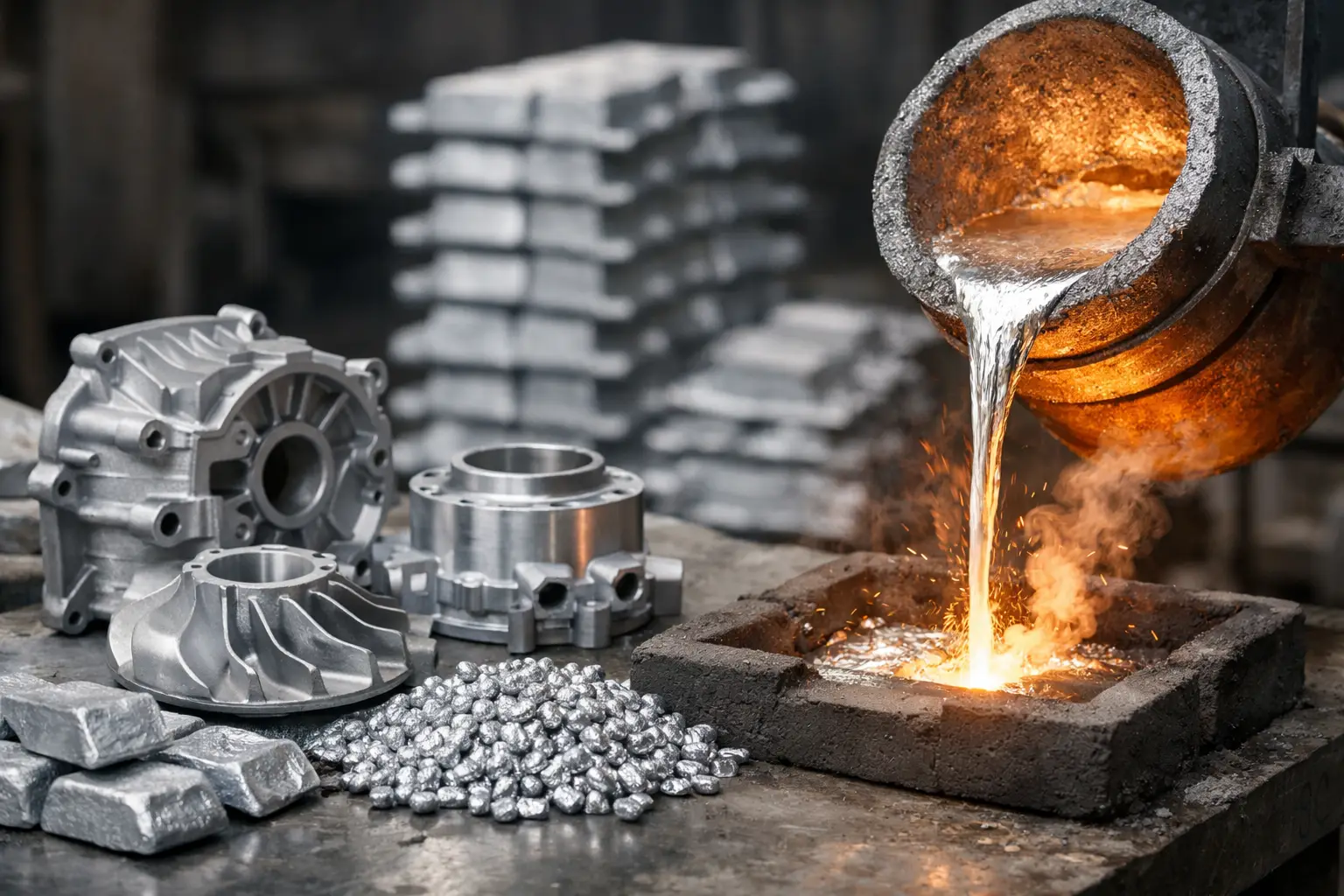
The casting process also changes the answer. Sand casting, die casting, and permanent mold casting do not reward the same alloy behavior. A grade that performs well in high-pressure die casting may not be the first choice for larger sand-cast parts where weldability or heat treatment carries more weight.
Best aluminium grades for casting by industrial use
When buyers ask for the best aluminium grades for casting, a few alloy families usually lead the discussion: A356, 319, 413, 535, and 380. Each has a clear role in industrial production.
A356 for strength and heat-treatable performance
A356 is one of the most widely specified casting alloys for good reason. It combines strong castability with useful mechanical performance after heat treatment. Its aluminum-silicon-magnesium chemistry gives it a strong balance of corrosion resistance, ductility, and strength-to-weight efficiency.
This grade is commonly used for wheels, structural castings, pump components, and aerospace-adjacent parts where lower weight matters but the casting still needs dependable strength. For buyers sourcing castings that must handle service loads and machining without becoming brittle, A356 is often a safe and commercially sound choice.
The trade-off is that process control matters. To get the best properties, foundries need proper melt treatment, degassing, and heat treatment. If the production route is inconsistent, the alloy’s potential can be wasted.
319 for automotive and general engineering castings
319 is a practical alloy for castings that need good machinability, pressure tightness, and moderate strength. Because it contains more copper than A356, it can support applications where mechanical performance and production efficiency matter more than maximum corrosion resistance.
Engine components, housings, and machine parts often use 319 because it casts well and supports cost-effective finishing. It is a strong option for buyers who need a proven alloy for high-volume industrial castings and who can manage the corrosion trade-off through coating, design, or operating environment.
This is where application context matters. If the part will live indoors or in controlled systems, 319 can be a very efficient choice. If the part faces salt, weather, or persistent moisture, another alloy may be the better long-term decision.
380 for die casting at scale
For pressure die casting, 380 is often near the top of the list. It offers very good fluidity, strong dimensional stability, and good productivity for complex parts with thin walls. That makes it popular in automotive parts, electronic housings, gear cases, brackets, and consumer-industrial components.
380 works especially well where buyers need repeatability and fast cycle times. It can support a commercially efficient program because it fills intricate dies well and helps reduce production bottlenecks. In large-volume operations, that processing advantage can matter more than chasing the highest possible tensile strength.
Its limits should still be understood. 380 is not usually the first choice where premium ductility or top-tier corrosion resistance is the main priority. It is a production alloy first – efficient, versatile, and well suited to demanding die-cast geometries.
413 for pressure tightness and fluidity
413 is another strong die-casting and pressure-tight casting alloy. It is known for excellent fluidity and good leak resistance, making it useful in hydraulic components, cylinders, and complex housings where soundness matters.
If a buyer is evaluating cast parts that must hold fluids or maintain dimensional accuracy in detailed shapes, 413 deserves attention. It can outperform other options in applications where castability and pressure performance are more important than top-end structural strength.
In practice, this grade can reduce headaches in production because it tends to cast intricate sections cleanly. That said, every gain comes with a question about end-use demands. If the part needs higher structural loading capability, another alloy may be more suitable.
535 for corrosion resistance
535 is valued for strong corrosion resistance, particularly in marine and outdoor service conditions. It is not the most commonly discussed casting grade in every industrial market, but when exposure conditions are aggressive, it can be the right answer.
For buyers focused on long service life in wet or corrosive settings, 535 can offer better durability than copper-bearing alternatives. That may justify a different purchasing decision even if the alloy is not the lowest-cost option on paper.
This is a typical procurement mistake in casting programs – comparing alloys only by upfront price. If one grade extends service life and cuts replacement frequency, it often produces the better commercial result.
How to choose the right casting grade for your operation
The correct grade starts with the part, not the alloy chart. Buyers should look at section thickness, required surface finish, pressure tightness, welding needs, machining allowance, and the service environment before settling on a specification.
If the project is structural or safety-related, A356 is often a strong starting point because it offers a proven balance of castability and mechanical strength. If the priority is high-volume die casting with good dimensional control, 380 is frequently more practical. If leak resistance is central, 413 may be the better fit. If corrosion is the primary concern, 535 becomes more attractive. If machinability and general engineering use matter most, 319 can be highly efficient.
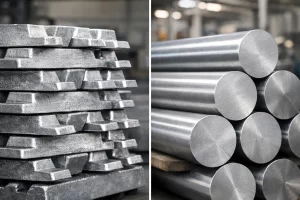
Supply consistency is just as important as alloy selection. Industrial buyers need dependable chemistry, repeatable ingot quality, and supplier support that aligns material grade with production use. That is especially relevant in bulk purchasing, where a small material inconsistency can affect large production runs.
For manufacturers sourcing primary aluminum inputs such as A7, A8, A9, or A6 ingots for downstream alloying and foundry use, purity and batch consistency directly affect casting quality. Clean feedstock supports tighter alloy control, lower contamination risk, and more predictable finished properties. For procurement teams working across markets such as China, Turkey, Vietnam, and Germany, stable grade specifications can be just as valuable as price competitiveness.
Common mistakes when evaluating casting alloys
One of the most common mistakes is choosing the strongest alloy on paper without considering castability. A stronger alloy that produces more porosity, hot tearing, or finishing problems can cost more overall than a slightly lower-strength option that runs cleanly.
Another mistake is ignoring corrosion conditions. Copper-bearing alloys may look attractive for strength and machining, but they are not ideal for every environment. The reverse is also true. A corrosion-resistant grade may be excellent technically but unnecessary if the component works in a controlled indoor setting.
Buyers also sometimes separate sourcing from manufacturing reality. The alloy should match the casting process, tooling, and production targets. A purchasing decision made only on price per ton rarely captures the full cost of rejects, machining time, coating requirements, or field failure risk.
A commercial view of casting grade selection
The best aluminium grades for casting are the ones that deliver the required part quality at the lowest real production cost. For some programs, that means A356 because performance after heat treatment matters. For others, it means 380 or 413 because die-cast productivity and shape complexity drive profitability. In corrosive environments, 535 may protect long-term value better than a cheaper alternative. In general engineering, 319 often remains a reliable and economical option.
Good casting outcomes start with realistic specifications and dependable metal supply. When buyers match alloy chemistry to process, environment, and volume requirements, they reduce waste and improve output. That is usually where the strongest purchasing decisions are made – not by picking the most famous grade, but by choosing the one that works hardest in the real production environment.
The best question is not simply which alloy is best. It is which alloy will keep your castings consistent, your rejection rate lower, and your finished parts competitive in the market.